Information
Location Tier Metropolis / Holy Capital World Eraedal Region Oceanside, Tarldet Plains (Western Empire) Coastal Waters Bay of Ptolus, Inland Sea (Connecting south to Sea of Scarlet Waters) Governing Power Triumvirate: Holy Emperor Rehobath, Commissar Igor Urnst, & The Council of Coin Population ~75,000 (Metropolitan Surface); ~15,000 (Transients, Delvers, & Undercity Outcasts) Defenses Dalenguard (Headquarters of 800 City Watch & Imperial Janissaries), Sea-Cliff Bastions, Sisterhood of Silence
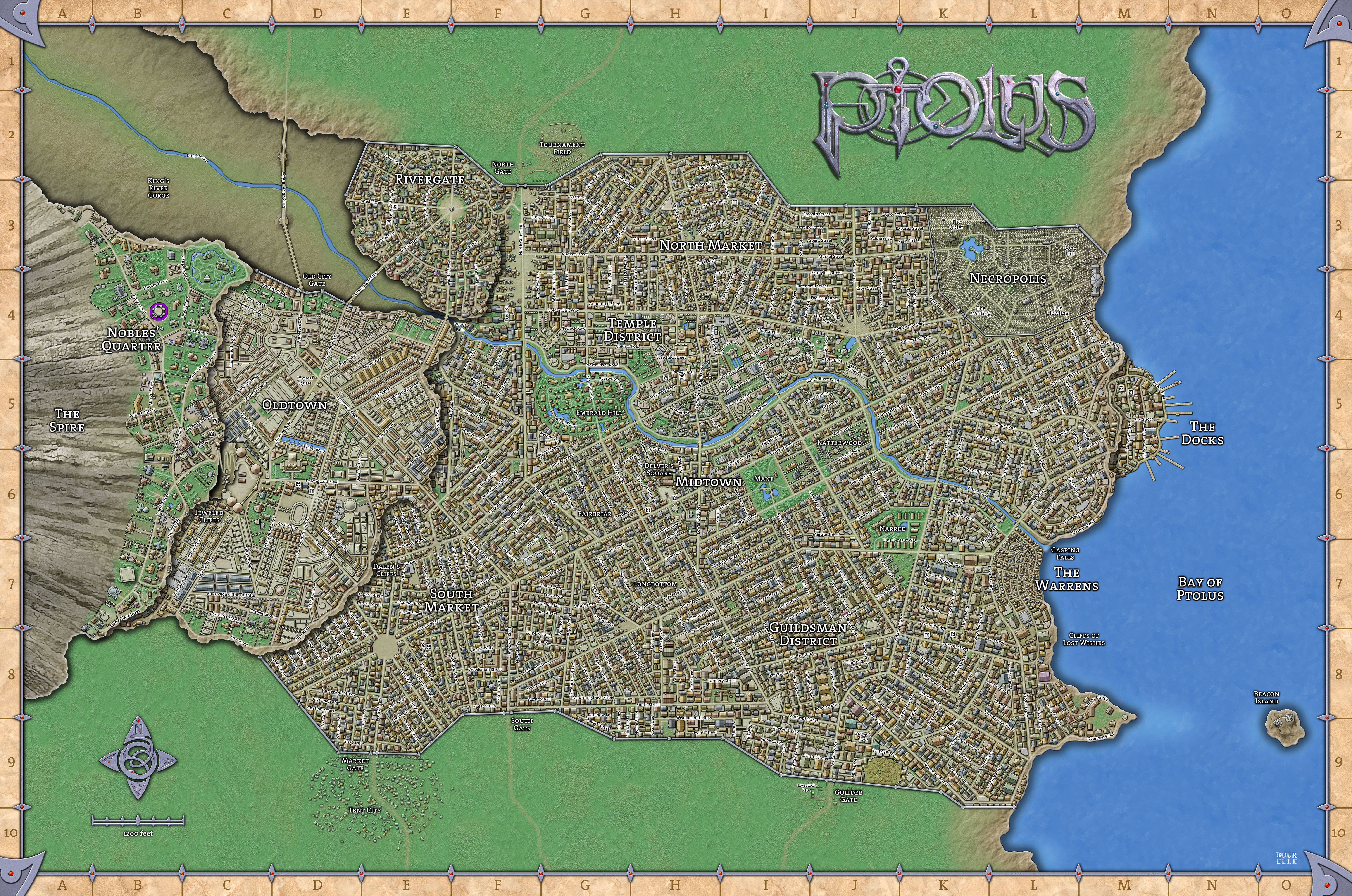
Image Credit: Cartography and Art from Ptol.us
📍 Overview: The City by the Spire & Holy Capital of the West
Ptolus is a monumental coastal metropolis of roughly 75,000 permanent residents, anchored upon the towering sea-cliffs of the eastern Tarldet Plains within the Western Empire. Perched at the terminus of the King’s River along the sheltered Bay of Ptolus, the city overlooks the vast Inland Sea and commands access to the southern shipping corridors that sweep past the Scarlet Mountains into the volatile Sea of Scarlet Waters.
The city is indelibly defined by the Spire—a colossal, unnatural needle of solid basalt rising nearly three thousand feet into the heavens above the coastal cliffs, crowned by the enigmatic ruins of Jabel Shammar.
Though long celebrated as a thriving free port, haven for arcane scholars, and boom-town for subterranean plunderers, the catastrophic collapse of the Western Empire’s ancient capital, Caer Itom, in 702 IA thrust Ptolus onto the center stage of continental politics. Today, Ptolus stands as the proclaimed Holy Capital of the Western Empire, housing Holy Emperor Rehobath Ylestos and his court in exile, even as secular imperial commanders, ancient noble houses, and cosmic abominations struggle for dominance beneath the Spire.
⚖️ Governance & The Tripartite Struggle
While the imperial heartland burns in the Three-way Civil War, Ptolus operates under a tense, razor-edged balance of three competing authorities:
                      ┌────────────────────────────────────────┐
                      │    The Tripartite Rule of Ptolus       │
                      └──────────────────┬─────────────────────┘
                                         │
         ┌───────────────────────────────┼───────────────────────────────┐
         ▼                               ▼                               ▼
┌─────────────────────────┐ ┌─────────────────────────┐ ┌─────────────────────────┐
│ The Holy Throne         │ │ The Imperial Citadel    │ │ The Plutocratic Oligarchy │
│ • Holy Emperor Rehobath │ │ • Commissar Igor Urnst  │ │ • The Council of Coin     │
│ • Prince Kirian         │ │ • Headquarters:         │ │ • The Ten Noble Houses   │
│ • Church of Aroden      │ │   Dalenguard            │ │ • Harbor & Mercantile   │
│ • Divine Imperial Claim │ │ • 800-Strong City Watch │ │   Monopolies            │
└─────────────────────────┘ └─────────────────────────┘ └─────────────────────────┘
-
The Holy Throne — Holy Emperor Rehobath Ylestos:
Following the sack of Caer Itom by the Cyclopean Vanguard in 702 IA, the Prince of the Church of Aroden, Kirian, welcomed his father, Rehobath, to the coastal city. Proclaiming that the fall of Caer Itom was divine retribution for imperial decadence, Rehobath declared himself the sole legitimate Emperor of the Western Empire and consecrated Ptolus as the realm’s Holy Capital. Supported by the Church of Aroden and the devout populace of Oceanside, Rehobath rules from the Holy Palace in the Temple District, demanding tithes and holy conscriptions to reclaim the Lion-Guarded Throne. -
The Secular Citadel — Commissar Igor Urnst:
The secular representative of imperial law and civil authority, Commissar Igor Urnst commands the city from the brooding stone fortress of Dalenguard. Supported by over eight hundred elite City Watch guards, battle-mages, and veteran Imperial Janissaries, Urnst maintains strict civil order, enforces the city’s anti-slavery laws, and prevents religious zealots from dragging Ptolus into suicidal foreign campaigns. -
The Plutocratic Oligarchy — The Council of Coin:
The de facto civic senate, dominated by the patriarchs and matriarchs of the ten ancestral The Noble Houses (such as the mercantile House Abanar, shadow-wielding House Sadar, and dragon-bonded House Dallimothan). The Council levies dock tariffs on the Bay of Ptolus, manages trade guilds, and finances delver expeditions, prioritizing commercial prosperity above both Rehobath’s crusade and the Commissar’s imperial mandates. -
The Silent Vigil — Sisterhood of Silence:
An autonomous, monastic order of vow-bound, nonspeaking female martial artists. Armed with enchanted batons and silken ropes, the Sisterhood roams the midtown avenues and harbor alleys, apprehending violent criminals without uttering a word and surrendering them to Dalenguard’s magistrates.
🗺️ City Districts & Architecture
Ptolus is constructed across four dramatic elevation tiers, separated by perpendicular rock bluffs and interconnected by fortified ramparts, arched stone bridges, and massive carriage elevators.
| District | Elevation Tier | Functional Role & Character |
|---|---|---|
| Nobles’ Quarter | Spire Shelf (Highest) | The summit of luxury, perched on the Spire’s lower buttress. Fortified estates of the ten noble families, lavish gardens, and the High Opera. |
| Oldtown | Upper Bluffs | Historic municipal district surrounding the citadel of Dalenguard, housing imperial administrative halls, courts, and the Grand Arena. |
| Temple District | Upper Bluffs | The theological hub of Eraedal, bisected by the Street of a Million Gods. Anchored by the Holy Palace of Rehobath Ylestos and cathedrals to Aroden, Iomedae, Abadar, Pharasma, and Sarenrae. |
| Midtown | Middle Plateau | The beating commercial heart of the city. Houses Delver’s Square, the premier gathering ground for adventurers seeking gear, tavern bounties, and dungeon rumors. |
| Rivergate District | Middle Plateau | Prosperous residential neighborhoods divided into gated cul-de-sacs called “burrows,” shielding burghers and guild officers. |
| North Market & South Market | Middle Plateau | Massive twin commercial hubs. North Market features lively open-air bazaars and farm produce from the Tarldet Plains; South Market houses established artisan guilds and banking counting-houses. |
| Guildsman District | Lower Terrace | Heavy industry, steamworks, foundries, and tanneries. Characterized by acrid smoke, churning waterwheels along the King’s River, and dense labor guilds. |
| Warrens | Lower Terrace | Squalid, lawless slum on the southwestern fringe. Lacking watch patrols, ruled by street gangs and cutpurses, and harboring outcasts and escaped slaves. |
| Necropolis | Distant Hills | A walled, necromantic necropolis built over rolling burial mounds. Patrolled day and night by the Keepers of the Pale to contain wandering undead and the demonic occupants of the Dark Reliquary. |
| Docks | Sea Level (Lowest) | Situated at the base of the eastern bluffs upon shifting sands along the Bay of Ptolus. Teems with privateers, whalers, smugglers, and merchantmen voyaging across the Inland Sea and south into the Sea of Scarlet Waters. |
| Undercity Markets | Subterranean | A sprawling subterranean frontier outpost carved into the upper vault levels directly beneath Midtown, where delvers trade illegal relics and ancient dwarven treasures. |
🕳️ The Dungeon, Dwarvenhearth, & The Ancient Bones
What sets Ptolus apart from every other metropolis in the Western Empire is the incomprehensible labyrinth of subterranean ruins beneath its streets, colloquially termed The Dungeon:
- The Sewer Conduits: The active municipal sewer network, engineered with massive iron sluice-gates discharging runoff eastward into the Bay of Ptolus.
- The Undercity Market: A subterranean haven where delvers hire guides, buy alchemical remedies, and fence dungeon artifacts away from the tax collectors of the Council of Coin.
- The Ghulvorn Labyrinths: Fortified subterranean complexes excavated centuries ago by the Half-God Ghul during the Ghul Wars, filled with biological abominations, necro-machinery, and arcane traps.
- Dwarvenhearth: A monumental, subterranean stone city carved by the dwarven race thousands of years ago and sealed during the Ghul Wars. Delvers who brave its labyrinthine gates return laden with mithral, magical relics, and ancient stonecraft.
- The Cosmic Prison of the Galchutt: Deep beneath the bedrock of the Spire slumbers the primordial nightmare—the imprisoned Galchutt (syncretized with the slumbering Old Ones of Palladium). Corrupting chaos-ichor seeps through deep tectonic fissures, spawning mutated horrors and fueling clandestine chaos cults operating in the dark underbelly of the city.
🔱 Key Factions & Cabals
The political undercurrents of Ptolus are rife with clandestine syndicates and mercenary orders:
- The Delver’s Guild: Based in Delver’s Square, this sprawling guild provides insurance, cartographic archives, rescue parties, and identification services for dungeoneers.
- The Dreaming Apothecary: A legendary and elusive cabal of arcane crafters who accept orders for high-grade magic items exclusively through dream visits, delivering completed treasures through planar transport.
- The Inverted Pyramid: A secretive arcane syndicate that survived the Western Empire’s historical Inquisitions. They meet within an extradimensional, inverted fortress suspended in the astral void directly above Ptolus.
- The Balacazar Family: The undisputed kings of the Ptolus underworld, operating extortion, narcotics, and smuggling cartels out of the Docks and Guildsman District.
- The Fallen & The Forsaken: A cell of fiendish entities residing within the Dark Reliquary of the Necropolis, worshiped by necromantic cultists who anticipate the awakening of the Old Gods.
🧭 Regional Integration: Western Empire & The Maritime Corridors
                       ┌─────────────────────────┐
                       │   The Inland Sea Trade  │
                       └────────────┬────────────┘
                                    │
                                    ▼
┌──────────────────────┐    ┌───────────────┐    ┌───────────────────────────┐
│   Tarldet Plains     │◄───┤  Bay of Ptolus│───►│  Sea of Scarlet Waters    │
│ • Agricultural Base  │    │  (Deep Harbor)│    │ • Southern Trade Passage  │
│ • House Wenglid      │    └───────┬───────┘    │ • Scarlet Mountains Gap   │
│ • Emancipated Armies │            │            │ • To Nimro & Baalgor      │
└──────────────────────┘            ▼            └───────────────────────────┘
                             ┌─────────────┐
                             │   PTOLUS    │
                             │ (The Spire) │
                             └─────────────┘
- The Shield of Tarldet: Ptolus relies on the expansive agrarian output of Oceanside and the newly emancipated standing armies of House Wenglid in the Tarldet Plains to shield its landward approaches from the barbarian hordes and the advancing forces of the Middle Kingdoms.
- The Inland Sea Highway: Through the Bay of Ptolus, the city maintains unfettered naval contact with the Eastern Territory, the islands of Phi and Lopan, and the northern kingdom of Bizantium.
- The Southern Passage: Merchant vessels bound for the Timiro Kingdom or the Floenry Isles pass south through the strait bounded by the Scarlet Mountains, navigating the treacherous red algae and boiling vents of the Sea of Scarlet Waters.